


10 Basic Italian Phrases for Travel
Going on an Italian adventure can feel scary if you don’t speak the language. Knowing some Italian Phrases for Travel can turn a good trip into a great one. Have you ever gotten lost because you couldn’t speak the language? You’re not alone.
Learning a few basic phrases can really help your trip. It’s not hard to learn the phrases you need to get around Italy with ease. Whether you want to learn Italian phrases for travel or just be ready, this article will show you the top 10 phrases. By the end, you’ll have the Italian Phrases for Travel to make your trip unforgettable.
Italian Travel Phrases
- Learn the top 10 essential Italian phrases for travel.
- Discover how to greet locals and ask for directions.
- Understand the importance of basic phrases in making your trip better.
- Find out how to order food and drinks like a local.
- Get tips on how to talk to locals effectively.
Why Learning Basic Italian Phrases for Travel Will Transform Your Italian Adventure
When in Italy, speaking the language can open doors to real experiences. You’re not just a tourist. You’re a traveler ready to dive into the local culture.

Italians love when visitors try to speak their language. It’s not just being polite. It’s about connecting with the culture and people.
By learning basic Italian phrases, you’ll find locals more friendly and helpful. This makes your adventure even more fun.
The Magic of Speaking Like a Local
Speaking Italian, even just a few phrases, can open doors to new experiences and encounters that you wouldn’t have had before. You can order food like a native, ask for directions, and talk to locals. This will make your trip richer.
How Italian Phrases Open Doors to Authentic Experiences
Learning essential Italian phrases lets you explore beyond tourist spots. You’ll find hidden gems, enjoy local food, and join cultural events. This makes your trip unforgettable.
As you learn Italian phrases for travel, your journey becomes more than sightseeing. It becomes a meaningful connection with the people and place.

Essential Italian Greetings and Courtesies
Getting ready for Italy? Learning basic greetings is key for a great trip. Italian culture values these social gestures a lot. Using them right can impress the locals a lot.
Buongiorno (bwohn-jor-noh) is great until the afternoon. It means “good day” but is used for hello. Use it in shops, restaurants, or when meeting someone new. At night, switch to buona sera (bwohn-ah seh-rah) for “good evening.” Say buona notte (bwohn-ah noht-teh) for “good night.”
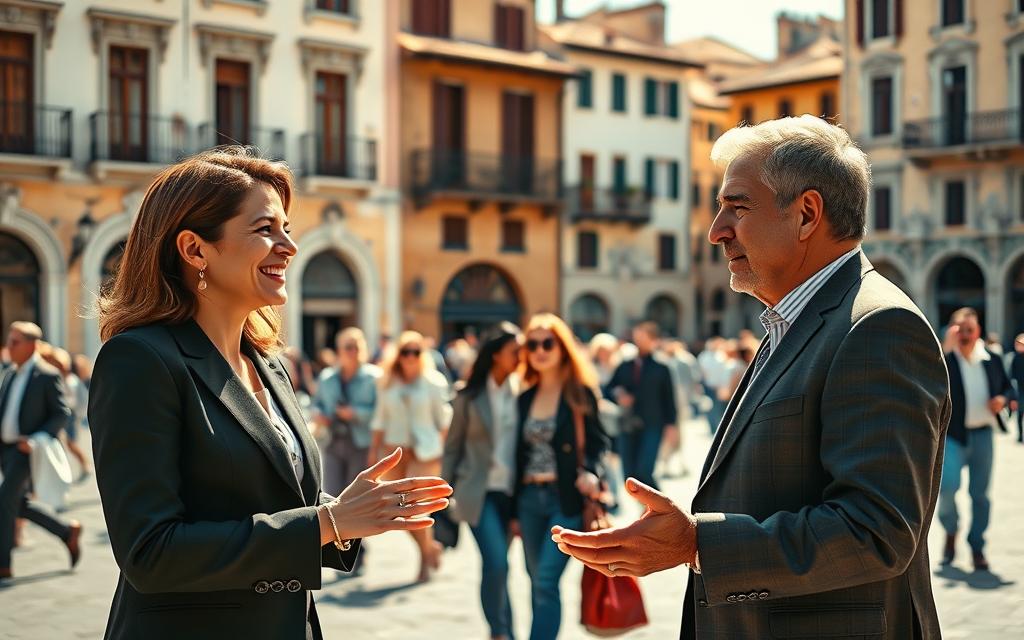
It’s also important to know basic courtesies like grazie (grah-zee-eh) for “thank you.” Say per favore (pehr fah-voh-reh) for “please.” These show respect and thanks for the culture.
Knowing the right greetings and courtesies makes everyday situations easier. For example, say per favore when you order food. Say grazie when it arrives. Showing respect and thanks makes your trip better.
Learn Italian Phrases for Travel: Getting Started
Traveling to Italy? Knowing basic Italian phrases can change your trip. You’ll feel more like a traveler, not just a tourist. Start by learning the basics of the Italian language.
Italian is easy to learn because every letter is pronounced. This makes it simple for beginners. Unlike some languages, Italian words sound like they’re written.

Pronunciation Tips for Beginners
To say Italian words right, focus on vowels and consonants. Italian vowels are pure and clear. For example, “e” is always said clearly, like in “hello.”
Consonants are easy, like in English. But watch out for double consonants. They get more emphasis, like in “anno” (year).
Common Mistakes to Avoid
Don’t mess up vowels. Italian vowels are clear and distinct. Also, remember to stress double consonants. This changes word meanings.
Practice with native speakers and listen to Italian media. Don’t worry about mistakes. The more you practice, the better you’ll get.
Ordering Food and Drinks Like a Native Speaker
Dining out in Italy is a special experience. Knowing the right phrases makes it even better. You’re not just ordering food; you’re diving into the local culture.
To start, ask for the menu by saying “Posso avere il menu, per favore?” This means “Can I have the menu, please?”
After picking your meal, it’s time to order. Say “Vorrei” and then your dish. For example, “Vorrei la pasta carbonara” means “I would like the pasta carbonara.”
If you want recommendations, ask “Cosa consiglia?” or “What do you recommend?”
When you’re ready for the bill, say “Il conto, per favore” or “Posso avere il conto?” This means “Can I have the bill?”
To pay, ask “Posso pagare con carta di credito?” to pay by credit card. Learning these basic Italian phrases for travel makes dining out more fun and real.
Ordering food like a local is more than just phrases. It’s about the whole experience. As you learn Italian phrases for travel, locals will appreciate your effort. It lets you enjoy true Italian food more.
Italian Phrases for Travel: Navigation and Transportation
Traveling to a new country can be scary. But, with the right Italian phrases, you’ll feel like a local. You can explore Rome’s streets or ride a gondola in Venice. Knowing how to ask for directions and use public transport is key.
Finding Your Way Around Cities
Getting lost in Italian cities is common. To find your way, ask locals, “Dov’è…?” which means “Where is…?” For example, “Dov’è la stazione?” means “Where is the train station?” It’s pronounced as “Doh-veh lah stah-tzee-oh-neh.”
Other helpful phrases are “Può mostrarmi sulla mappa?” or “Can you show me on the map?” and “Dov’è il centro città?” which means “Where is the city center?”
Key Phrases for Navigation:
– “Dritto” means “straight”
– “A sinistra” means “to the left”
– “A destra” means “to the right”
– “Davanti a” means “in front of”
– “Dietro” means “behind”
Public Transport Terminology
Italy’s public transport is efficient. You’ll need to know some basic terms. For example, “biglietto” means “ticket,” and “orario” means “schedule.” When buying a ticket, say, “Un biglietto per…, per favore” or “A ticket to…, please.”
To ask about the schedule, say “Qual è l’orario?” or “What’s the schedule?”
Tips for Using Public Transport:
– Validate your ticket before boarding by using a “validatore” or ticket validator.
– Remember, “partenza” means “departure,” and “arrivo” means “arrival.”
Shopping and Money Matters in Italian
As you explore Italy’s markets and shops, knowing some Italian can help a lot. You can ask for what you want, talk prices, and get to know the culture better.
When you shop, start with “Vorrei…” (I would like…). It’s a nice way to show interest in something. For example, “Vorrei una camicia bianca, per favore.” (I would like a white shirt, please.)
To ask about the price, say “Quanto costa questo?” (How much is this?). This helps you stay within your budget and avoid surprises. If you want to try something on, ask “Posso provarlo?” (Can I try it on?).
Knowing about the local money is also important. Italy uses the Euro. You might need to find where to exchange money or use an ATM. Asking “Dov’è il bancomat più vicino?” (Where is the nearest ATM?) can be very helpful.
Learning these useful Italian phrases for shopping makes your trip better. It shows respect for the local culture and makes your experience more authentic and fun.
Emergency and Health-Related Italian Phrases
Knowing the right phrases in Italy can save your life in an emergency. This includes medical issues, accidents, or any need for help. Being able to talk clearly can really help.
Medical Terms You Should Know
For medical emergencies, knowing key terms is vital. If you need a doctor, say “Ho bisogno di un dottore” (I need a doctor). Say it like “Ho biz-ohn-nyo dee oon dot-tor-reh.”
Other helpful phrases are “Sto male” (I’m not feeling well) and “Dov’è l’ospedale più vicino?” (Where’s the nearest hospital?).
Getting Help When You Need It
In emergencies, time is very important. If you’re in trouble, call for help. Say “Aiuto!” (Help!), like “Ay-oo-toh.”
If lost or needing directions, ask “Dov’è…?” (Where is…?). For example, “Dov’è la farmacia più vicina?” means “Where’s the nearest pharmacy?”
Knowing how to report incidents or ask for help from authorities is also good. Say “Devo denunciare un furto” (I need to report a theft) or “Ho bisogno della polizia” (I need the police).
Cultural Tips for Using Italian Phrases
Exploring Italy means more than just talking. It’s about showing respect for the culture and people. Italians are known for their warmth. So, don’t be shy to ask for help.
Trying to speak Italian makes your trip better. It’s not just about respect. It’s also about enjoying your time more.
Knowing when to use formal or informal language is key. The right form of address matters a lot. For example, formal language is best for older people or those in charge.
This shows respect and can make your interactions better.
Showing appreciation is very important. Saying “grazie” (thank you) or “per favore” (please) shows you’re grateful. By following these tips, you’ll use Italian phrases better and have a real Italian experience.
Conclusion: Embracing Italy Through Language
Learning Italian phrases can change your trip to Italy. Just a few words can help you feel more confident. You’ll get to know the country better.
Knowing basic italian phrases for travel makes your trip better. It lets you talk to locals in a real way. Learning these phrases makes simple talks more special.
Using Italian makes your trip more fun. You’ll make memories that last forever. So, use what you’ve learned and explore Italy like a local.
